
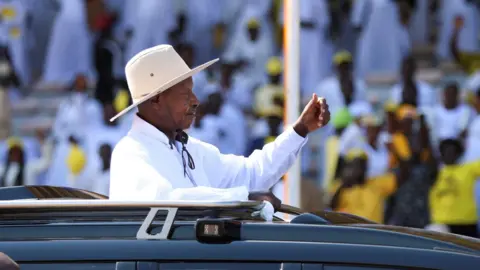
On a sun-drenched day in May 2026, Ugandan President Yoweri Museveni was sworn in for a record seventh term, marking him as one of the longest-serving leaders on the African continent. The ceremony at the country's parliament building in Kampala was attended by dignitaries from across East Africa, despite growing tensions over Museveni's controversial re-election and his increasingly assertive foreign policy.

Context

To understand the significance of Museveni's seventh inauguration, one must delve into Uganda's political landscape and its regional dynamics. Since seizing power in 1986, Museveni has shaped Uganda's trajectory through a mix of economic liberalization, military assertiveness, and political control. His National Resistance Movement (NRM) party has maintained a stranglehold on Ugandan politics, with few viable alternatives emerging.
Facts

Museveni's path to a seventh term was fraught with controversy. He faced off against young challengers, including musician-turned-politician Bobi Wine and former academic Lukwago Ssegamirola in the 2021 elections. Despite allegations of widespread voter intimidation, internet shutdowns, and electoral fraud, Museveni's victory was upheld by Uganda's Supreme Court.
Human Impact
Museveni's prolonged rule has had a profound impact on Uganda's political landscape, stifling dissent and marginalizing opposition voices. Human rights groups have documented increasing crackdowns on civil society organizations and the media. As Museveni doubles down on his security-centric approach to governance, the Ugandan public faces growing economic challenges, with high levels of youth unemployment and rising food prices.
Analysis
Museveni's record seventh inauguration comes at a critical juncture for East Africa. As regional tensions rise, with Uganda increasingly aligned with autocratic powers and at odds with Western democracies, Museveni's approach risks isolating the country internationally. Meanwhile, within Uganda, his prolonged rule may further erode democratic institutions and civil liberties, raising concerns about the future stability of this key regional player.
Counterpoints
Supporters of Museveni's government argue that his leadership has brought stability, economic growth, and relative peace to Uganda. They point to the country's improved healthcare outcomes, increased agricultural productivity, and strong foreign reserves as evidence of Museveni's success. Furthermore, they claim that the opposition's allegations of electoral fraud lack substance and are driven by political opportunism rather than factual concerns.
What Happens Next
As Museveni begins his record seventh term, key signals to watch include the government's response to growing economic challenges and the state of democratic space in Uganda. Observers should also monitor Uganda's regional posture, particularly its relations with autocratic powers like Eritrea and Libya. Additionally, the international community's engagement with Uganda will be crucial, as Western democracies navigate their relationships with an increasingly assertive and authoritarian Kampala.
Takeaway
The single most important takeaway from Museveni's record seventh inauguration is the urgent need for a serious dialogue on Uganda's political future. With democratic space shrinking, economic challenges mounting, and regional tensions rising, it is imperative that Ugandans—regardless of their political beliefs—engage in constructive conversations about the kind of country they want to live in and the values they wish to uphold.