
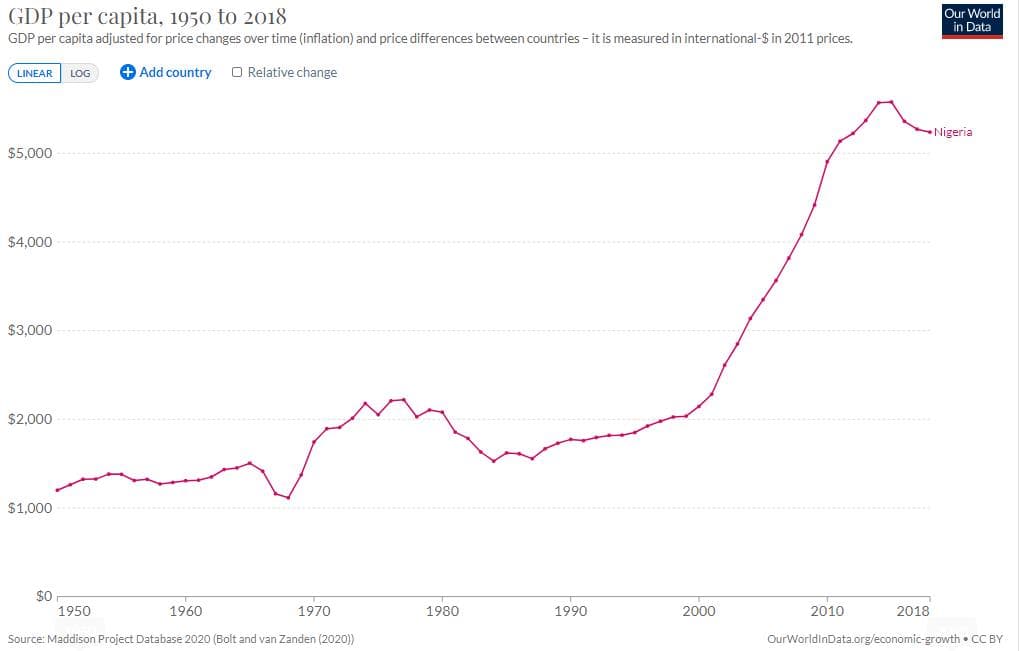
The Nigerian economy expanded by 3.89% year-on-year in the first quarter of 2026, a slowdown from the previous quarter's growth rate, despite gains in telecommunications, financial services, trade, and agriculture partially offsetting persistent weaknesses in crude oil production and electricity supply.
Context
Nigeria's economy has been grappling with the challenges of diversifying its revenue sources away from crude oil exports, which have been impacted by global price fluctuations and production hiccups. The country's reliance on crude oil exports for over 85% of its export earnings and a significant portion of government revenue has left it vulnerable to external shocks.
Facts
The Nigerian Gross Domestic Product (GDP) grew by 3.89% year-on-year in real terms in the first quarter of 2026, according to data released by the National Bureau of Statistics (NBS). This growth rate was higher than the 3.13% recorded in the first quarter of 2025.
Human Impact
The slowdown in economic growth and persistent sectoral imbalances have significant implications for Nigeria's population, particularly those working in the oil and gas sector. The decline in crude oil production and electricity supply has led to job losses, reduced disposable income, and a general slowdown in economic activities across the country.
Analysis
The Nigerian economy's continued reliance on crude oil production and the electricity sector, despite their persistent weaknesses, highlights a need for structural economic reforms to promote diversification. The non-oil sectors, such as telecommunications, financial services, trade, and agriculture, have played an increasingly important role in supporting overall growth.
Counterpoints
Some analysts, such as Dr. Muda Yusuf of the Centre for the Promotion of Private Enterprise (CPPE), argue that Nigeria's economic growth is still on a gradual recovery path and should be viewed with cautious optimism. They point to the growth in non-oil sectors as evidence that the economy is showing resilience.
What Happens Next
The outlook for Nigeria's economy in the coming quarters will largely depend on the government's ability to implement structural economic reforms, such as investing in renewable energy sources and promoting private sector-led growth. Market participants should closely monitor key indicators like electricity generation capacity, crude oil production levels, and the performance of non-oil sectors.
Takeaway
Market participants should not overlook the significance of non-oil sectors in driving Nigeria's economic growth and should closely monitor key indicators like electricity generation capacity, crude oil production levels, and the performance of non-oil sectors to gauge the country's prospects for sustained growth.